|
|
|
|
|
|
|
Welcome
|
News
October 2024 Congratulations to Dr. Pyayt on her Rising Star Award from the Academy of Science, Engineering, and Medicine of Florida!
May 2024 Congratulations to Dr. Pyayt on her awarded proposal supported by First Lady Casey DeSantis Cancer Innovation Fund!
February 2024 Congratulations to Dr. Pyayt on her awarded NSF proposal!
January 2024 Congratulations to Dr. Pyayt on becoming a President of the USF Chapter of the National Academy of Inventors!
January 2024 Congratulations to Dr. Pyayt on becoming a Secretary of the USF Chapter of the National Academy of Inventors!
February 2022 Congratulations to Dr. Pyayt on her election as a senior member of the National Academy of Inventors!
January 2022 Congratulations to Howard on defending his doctoral degree!
August 2021 Congratulations to Dr. Pyayt for winning support from the Interstellar Initiative in the area of Healthy Longevity!
December 2020 Congratulations to Hao on defending his doctoral degree!
June, August 2020 Congratulations to Dr. Pyayt on her awarded proposals from Amazon,
Florida High Tech Corridor and USF Rapid Response Research Grant!
|
IBIS - Innovative Biomedical Instruments and Systems lab
performs research on software and hardware applied to
advanced diagnostics, imaging and treatment. Our research lies on the border
of AI, Deep Learning, bioimaging and microfluidics.
We take a quantitative approach to technology design, and take projects
all the way from careful design and optimization to
fabrication and application to real word problems.
The head of the IBIS lab is Dr. Anna Pyayt. She is an Associate Professor at the University
of South Florida (USF) in the Department of Chemical, Biological, and Materials Engineering.
She earned a dual Ph.D. in Electrical Engineering and Nanotechnology from the University of
Washington and completed a Computing Innovation Fellowship at Stanford University.
During her PhD she interned at Microsoft Research and HP Labs, she worked with Garry Starkweather
(Laser Printer Inventor) and together they patented a new display technology “Telescopic Pixel”.
Dr. Pyayt has pioneered technologies in AI, mobile health, and assistive devices for individuals
with blindness. Her Mobile ELISA technology for early detection of pregnancy complications gained
international recognition and was a finalist in competitions such as XPrize. Her current research
focuses on AI-driven cancer treatment optimization and scientific information extraction, supported
by grants from the National Science Foundation and by the Casey DeSantis Cancer Innovation Fund.
These projects are in collaboration with Moffitt Cancer Research Center and Florida State University.
Dr. Pyayt holds multiple biomedical technology patents and is the founder of Hemolix LLC.
She has presented her work at the U.S. Congress and the National Academy of Sciences, and her
innovations have won numerous awards, including the University of South Florida Excellence in
Innovation Award and Rising Star Award from the Academy of Science, Engineering, and Medicine of
Florida. Dr. Pyayt is a Senior member of the National Academy of Inventors (NAI) and the President
of the USF NAI Chapter.
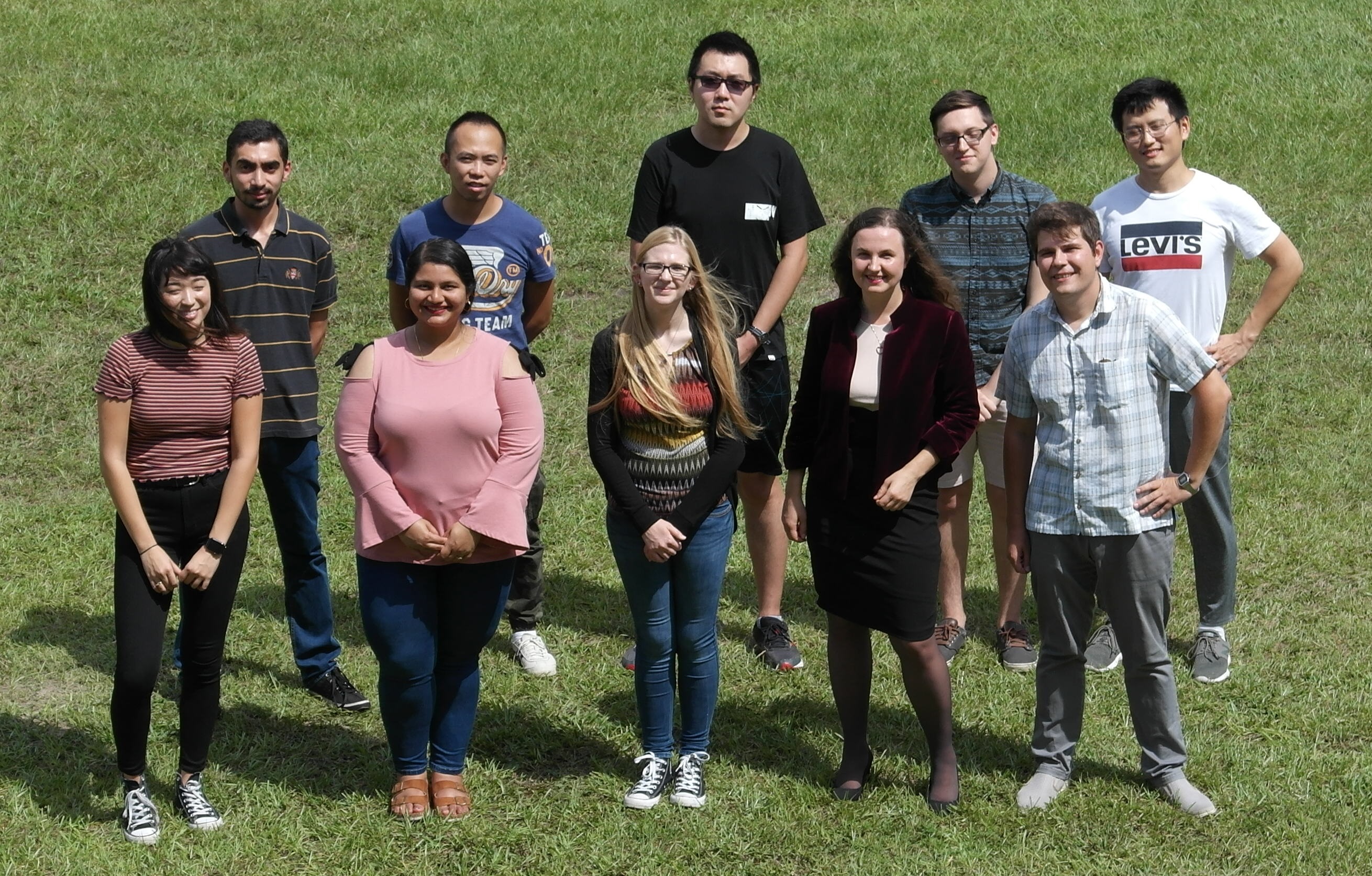
Prof. Pyayt's Research Group
|
|
|